
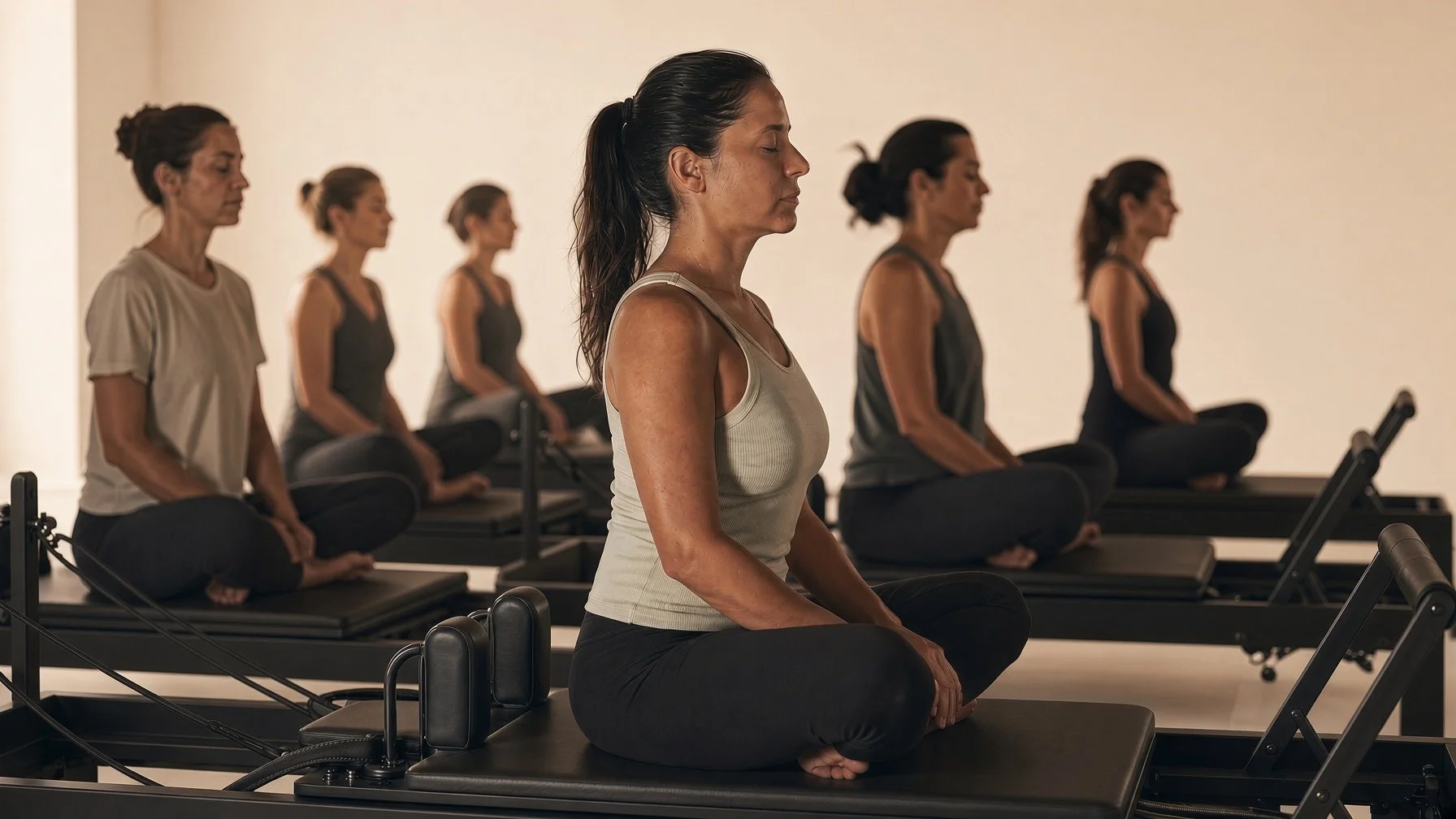
Can Pilates improve your mental health?
1 Oct 2026
Short answer: yes, we think it can. And it's not only us saying so! Lots of controlled trials link regular Pilates to fewer symptoms of anxiety and depression, more energy and better sleep.
It's not a cure, and it's not a treatment on its own. We'll come back to that. But the evidence does point one way, so here's what the research says, plus a few things we've learned since opening Sculpt.
Is Pilates good for anxiety and depression?
Honestly, the best evidence we've got says yes.
The study worth knowing about from a few years ago was ‘The effects of pilates on mental health outcomes: A meta-analysis of controlled trials’ People doing Pilates reported fewer symptoms of depression and anxiety, less fatigue and more energy than people who weren't.
What we love about that is it wasn't one thing. Anxiety, low mood, tiredness, energy: all four moved the right way. People weren't only feeling better. They had more in the tank, and that's exactly what we want you to walk out of class with.
Why does Pilates help your mental health?
Nobody's pinned it down to one thing. But here's our best guess at why it works, and it's what we build our classes around.
You can't think about anything else. Pilates is small, precise, controlled movement. Try rehearsing tomorrow's meeting while holding a single-leg bridge on a moving carriage. You can't. For an hour your head has one job, and when did that last happen.
You actually breathe. Every movement is timed to the breath, so it slows right down. Slow, steady breathing is one of the simplest ways to settle your body, and it's the first thing to go when you're stressed.
You get stronger, and you notice. On the reformer you can feel yourself improving. A heavier spring. A longer hold. A move that used to make your legs shake and now doesn't. That feeling does a lot for you. It's the thinking behind The Load, our weight-focused reformer class.
You'll keep doing it. The best exercise for your head is the one you'll still be doing in six months. Low impact, a set class time, a room you look forward to walking into. And on the days you can't get to us, The Vault has mat classes you can do at home.
Why the people matter as much as the Pilates
This is the bit we care about most. The exercise is only part of it. There are five key steps to improving your mental health: connect with other people, be physically active, learn new skills, give to others, and pay attention to the present moment.
A good class ticks off four of those in an hour. You move, you learn something, you concentrate, and you do it in a room full of other people.
That last one is the whole reason we built Sculpt as a social wellness club and not just a studio.
Common questions about Pilates and mental health
Can Pilates help with anxiety? It can. Controlled trials have found fewer anxiety symptoms in people doing regular Pilates. The studies are small, so think of it as a support, not a cure.
Is Pilates good for depression? The research so far points to fewer depressive symptoms with regular Pilates. It works best alongside professional support where that's needed, never instead of it.
Is Pilates or yoga better for mental health? Yoga has more research behind it. Pilates has less, but what's there is positive. Honestly, the better one is the one you'll keep going to.
How quickly will I feel a difference? You might feel calmer straight after a class. The trials that measured lasting change ran over weeks, not days, so give it a bit of time.